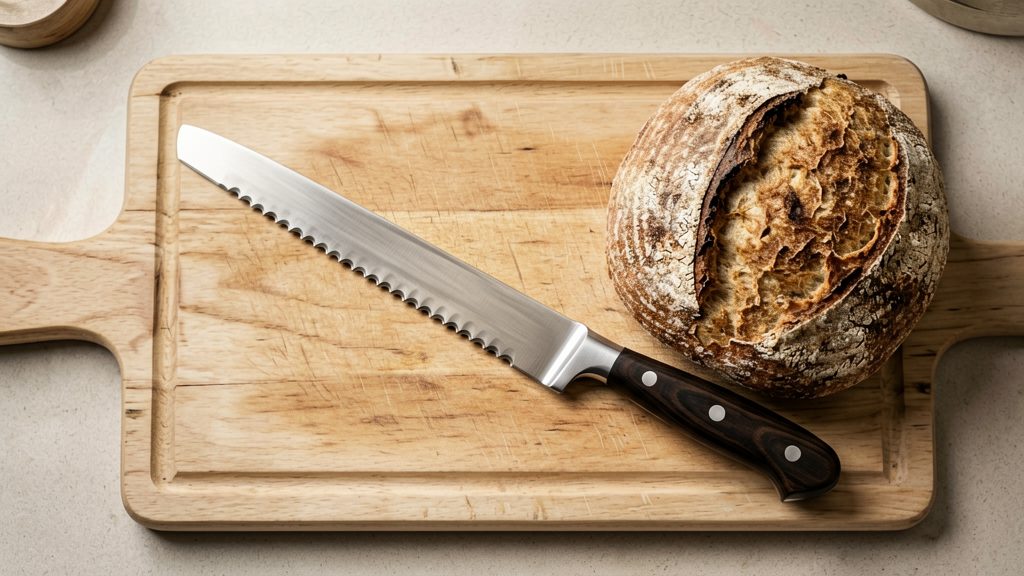
For a home baker seeking the best bread knife with a scalloped edge for sourdough, the SB-105 is my first recommendation. It combines the requested edge style with a long slicing blade and access to manufacturer sharpening. The right alternative depends on handle comfort, loaf size, and whether you prefer a heavier knife. See the manufacturer’s product specifications and sharpening service.
Which bread knife models are worth comparing?
The following are concrete models with different reasons to consider them. The edge descriptions retain each manufacturer’s terminology.
| Model | Manufacturer’s edge description | Published blade length | Recommendation |
|---|---|---|---|
| SB-105 Bread/Roast Slicer | Scalloped serrations | 10.75 inches in specifications | First choice for the requested edge style |
| MSB-105 Bread/Roast Slicer | Scalloped serrations | 10.75 inches in specifications | Alternative for buyers who prefer more weight |
| M23210 Wavy Edge Wide Bread Knife | Wavy edge | 10 inches | Alternative focused on handle texture and a finger guard |
Sizing qualification: Both scalloped slicers use 10½ inches in their product names, which differs from their specification tables. Confirm the usable blade length with the manufacturer if a storage slot or slicing guide requires an exact fit.
SB-105: the default scalloped choice
Its slightly curved blade is suited to a draw-and-return slicing motion. Start here if your main requirement is the explicitly identified scalloped edge and you have no particular preference for additional knife weight. Its listed weight is 5.6 ounces, and blade thickness is 2.0 mm, according to the manufacturer.
MSB-105: the heavier alternative
This model is listed at 6.6 ounces, also with a 2.0 mm blade thickness. Those specifications make weight a useful comparison point; they do not establish that it will cut a particular crust more easily. If possible, hold it before buying and judge whether its balance feels comfortable during repeated forward-and-back movements. See the manufacturer’s specifications.
M23210: the textured-handle alternative
This model has a synthetic handle combining a softer grip material with polypropylene, textured finger points, and a protective finger guard. Its stamped blade is described as high-carbon Japanese steel. Consider it when secure handle contact is your main purchasing priority. The manufacturer calls its edge wavy, so inspect a close-up photograph before treating it as interchangeable with your preferred scalloped profile. These features are documented on the product page.
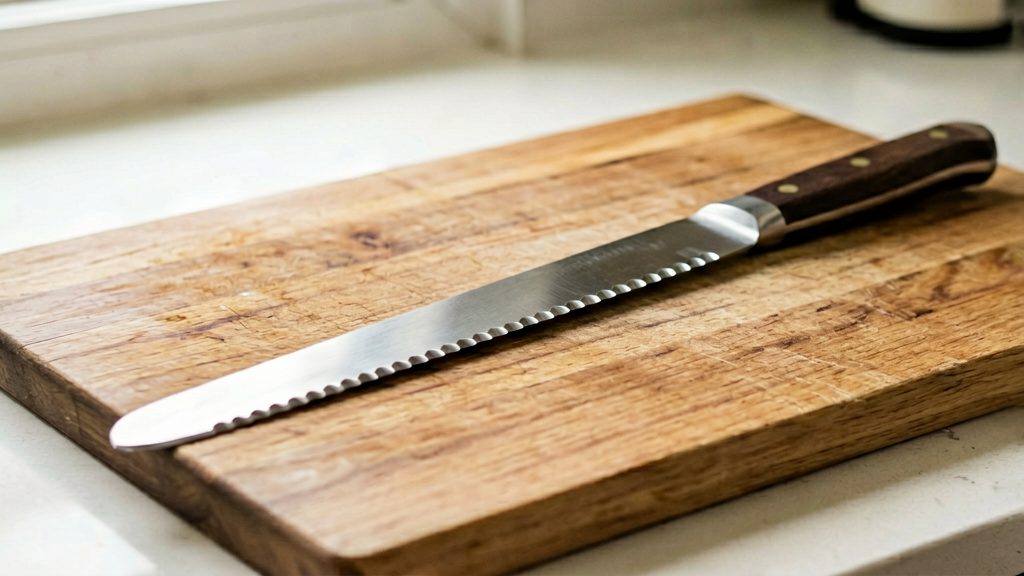
Why does the edge shape matter for sourdough?
Sourdough presents contrasting cutting demands: a resistant crust surrounding a softer interior. The edge needs to establish a cut in the exterior while the blade passes through the crumb without excessive compression. The M23210 manufacturer specifically describes its teeth as penetrating tough crust while helping protect the interior from tearing, on its product page.
Treat edge terminology as a starting point for inspection. Look at the actual cutting edge, including the shape and spacing of its repeated curves and teeth. A broad description such as scalloped or wavy does not tell you everything about how an individual knife will behave.
Choose for your usual loaf rather than assuming that an edge category guarantees the cleanest cut. A deeply baked boule and a softer sourdough sandwich loaf place different demands on the knife. The useful result is a controlled cut through both exterior and interior, without having to force the blade.
How do you match blade length and handle to your loaf?
Compare the cutting edge with the widest part of the bread you regularly buy or bake. You need working room for the blade to travel while remaining engaged with the loaf. A knife that barely spans the bread leaves less room for a comfortable stroke.
Blade length and overall knife length are different measurements. The handle contributes to storage requirements but does not increase cutting reach. When shopping online, check which measurement a listing actually displays.
Evaluate these fit points before choosing:
- Loaf shape: Measure a broad round loaf across its intended cutting direction. For an oval loaf, consider the width where you normally begin slicing.
- Knuckle clearance: With the knife sheathed and held normally over your board, check whether your hand can approach board level comfortably. Do not compensate for poor clearance by adopting an awkward wrist position.
- Handle fit: Your fingers should wrap securely without being crowded against the guard or the blade’s heel.
- Working space: Allow room beyond the bread for the tip’s travel. A backsplash, appliance, or nearby person should not obstruct the stroke.
A longer blade is useful only when you can control it comfortably. Someone slicing compact loaves in a confined kitchen may prefer a different fit from someone routinely cutting wide boules. Keep the sheath on during handling comparisons, and follow the retailer’s rules for inspecting knives.
How do you slice sourdough without crushing it?
Let the bread finish cooling
For freshly baked sourdough, wait until the loaf has cooled completely before evaluating the knife’s cutting performance. A baking school’s sourdough guidance, published in 2024, recommends complete cooling before slicing. This also prevents you from confusing a warm loaf’s behavior with a knife problem.
Secure the cutting surface and position your hands
Use a cutting board with enough space to support the loaf. University of Illinois Extension recommends placing a damp kitchen towel underneath a board to prevent slipping, using a board rather than a plate or countertop, and keeping the supporting hand’s fingers curled away from the blade. See its cutting-tool safety guidance.
Place the bread on its stable base. Hold it on the side away from the intended slice, keeping your thumb and fingertips outside the blade’s full forward-and-back path. Your supporting hand should steady the loaf without squeezing it flat. Stop and reposition if the bread rocks or your fingers approach the cutting line.
Establish the cut, then use the blade’s travel
Begin with controlled strokes to establish a track in the crust. Once the blade is engaged, lengthen the sawing motion and let the edge do the work. The SB-105 manufacturer recommends long sawing strokes with minimal downward pressure in its usage instructions.
Keep the blade aligned with the intended slice instead of twisting it sideways to correct direction while it is buried in the loaf. Slow down as you reach the bottom crust. Continue the slicing action until the slice separates; do not finish by chopping the edge into the board.
If the knife repeatedly skates across the crust, stop before increasing force. Recheck the bread’s stability and the blade’s condition before continuing.
When should you sharpen, repair, or replace the knife?
Assess maintenance from changing behavior on comparable bread. A knife that previously started the cut readily but now slides, snags, or demands noticeably more effort deserves inspection. Do not judge sharpness by running a finger along the edge.
Under good light, look for damaged teeth, chips, bending, and movement where the handle meets the blade. Remove a knife with a loose handle or substantial blade damage from use until the manufacturer or a qualified repair service has assessed it. Sharpening cannot correct every structural problem.
Choose a method that matches the serrations
A scalloped knife requires attention to its existing edge geometry. For compatible concave serrations, a sharpening-tool manufacturer’s serrated-knife instructions describe matching a tapered abrasive rod’s diameter to the serration and keeping the abrasive flush with the bevel—the sloping surface leading to the cutting edge.
That is a tool-selection principle, not permission to use the same procedure on every scalloped profile. Ask the knife manufacturer which abrasive shape and technique suit your exact model. Follow those instructions for sharpening and any burr removal, and keep your hands outside the abrasive’s travel.
Use a pull-through or electric sharpener only when its instructions explicitly cover your knife’s edge type and identify the appropriate setting or stage. Avoid assuming that general compatibility with kitchen knives includes every serration pattern.
Check service compatibility before sending a knife
The SB-105 manufacturer explicitly includes that model in its serrated sharpening service. Its service policy also says it typically does not sharpen other manufacturers’ serrated edges without prior review. Ask any service whether it can preserve the original profile, and provide the model number and clear photographs when requested.
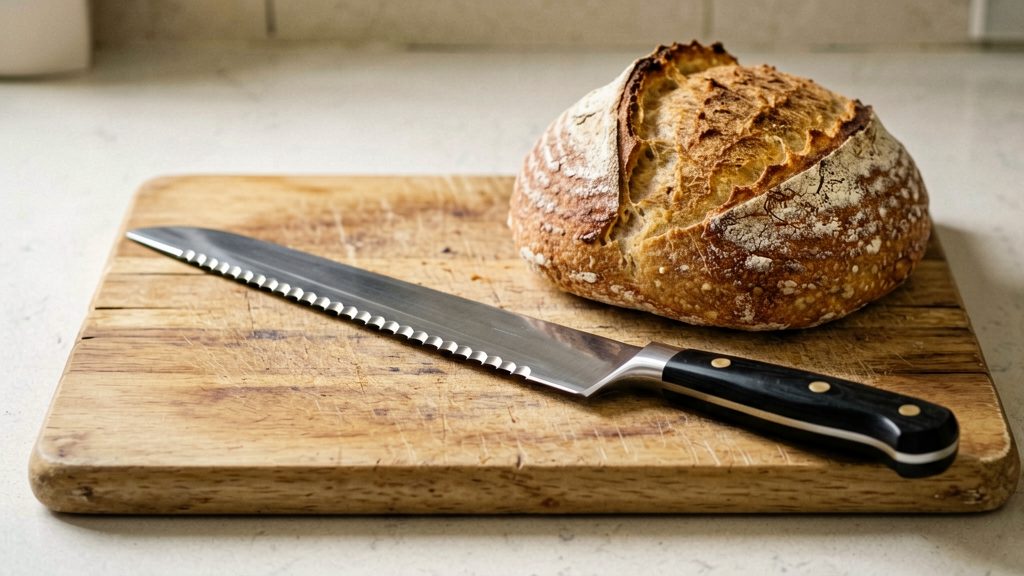
How do you clean and store a long bread knife?
After use, carefully hand-wash the knife with warm water and dish soap, rinse it, and dry it thoroughly. Avoid prolonged soaking and keep it out of the dishwasher. The M23210 manufacturer’s care instructions explain that dishwasher conditions can damage handles, dull edges through contact, and contribute to staining or pitting.
During cleaning, keep the cutting edge directed away from your hand. Never leave the knife hidden beneath cloudy dishwater, where someone could reach onto it.
Store the dry knife in a suitable sheath, fitted drawer organizer, or block that accommodates its full length. Check that the tip cannot protrude and that the edge does not scrape against other utensils. The same manufacturer’s care guidance recommends protected storage to preserve cutting edges and reduce injury risk.
Before putting the knife away, remove any bread residue caught around the serrations or handle junction. A clean, protected blade is easier to inspect the next time you use it.
Frequently asked questions
Can the SB-105 or MSB-105 cut a frozen sourdough loaf?
Thaw the loaf first. Their manufacturer identifies frozen items as foods to avoid cutting with its knives in its use and warranty guidance.
What should a left-handed buyer check before ordering?
Ask the manufacturer whether the exact model’s handle and edge grind suit left-handed use. Request photographs of both blade faces and check the seller’s return policy if you cannot try the knife.