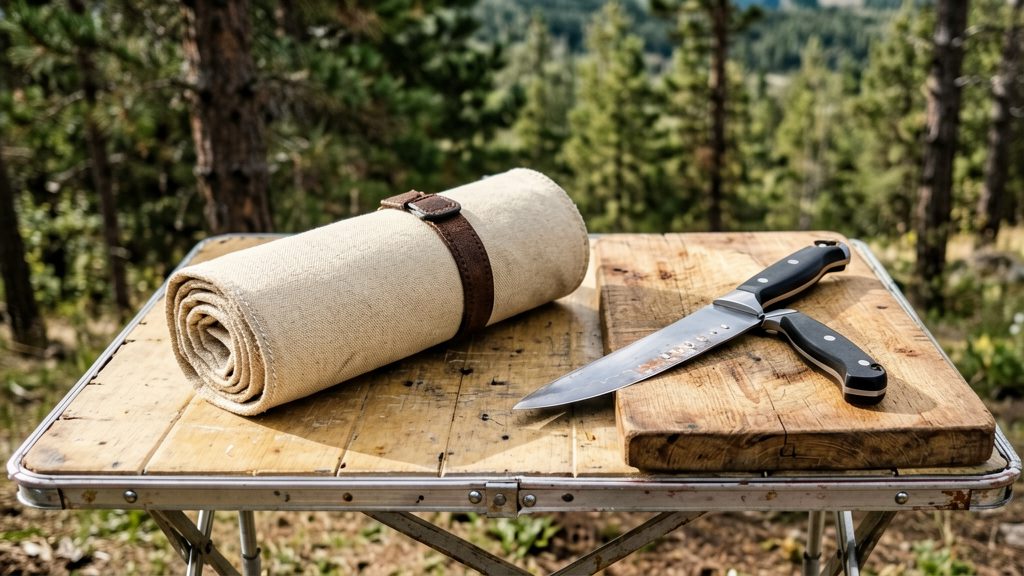
The best knife storage for camping and outdoor knives combines complete blade coverage, reliable retention, and a container suited to your trip. A fitted sheath handles individual fixed blades; a knife roll organizes a cooking kit; a properly fitted hard case adds protection during demanding transport. Choose around the knives you actually carry, including their handles and protective covers, rather than advertised pocket capacity alone.
Which storage models suit different camping needs?
These models serve different purposes. The recommendations below depend on their construction and published specifications, with practical tradeoffs for carrying knives.
| Exact model | Recommended application | Verified storage details | Main buying consideration |
|---|---|---|---|
| Outdoor Camp Kitchen Tool Roll | Organizing existing camp cooking knives and utensils | Four deep pockets with covering flaps, plus a large zippered pocket | The manufacturer specifies sheathed knives for its horizontal pockets. Product details |
| Nomad Cooking Kit | Buying a folding food-preparation kit with integrated storage | Five-piece kit; listed complete-kit weight of 14 ounces; microfiber cloth doubles as a carrying pouch | This purchase includes cutting tools and a board, rather than simply providing an empty organizer. Product specifications |
| R40 Personal Utility Ruck Case | Enclosing compact knives when outside water exposure is a concern | Published interior dimensions: 7.63 × 4.70 × 1.90 inches | Check the assembled knife package against the usable interior, including the installed organizer and tray. Product specifications |
Outdoor Camp Kitchen Tool Roll: for an existing cooking setup
Its adjustable closure accommodates changes in the load, while hanging loops and a strap provide access at camp. The fabric is described as resistant to stains and punctures. Treat puncture resistance as a durability feature, not permission to insert exposed edges. A soft organizer should not become the cutting edge’s only barrier against your hand.
Nomad Cooking Kit: for a matched folding setup
The included tools comprise a serrated folding knife, a corkscrew folding knife with bottle opener, and a folding peeler, alongside the board and carry cloth. The manufacturer’s September 24, 2018 introduction describes locking rings that secure the knife blades open or closed and a quick-drying microfiber wrap.
The purchasing decision is whether those included tools suit your cooking. Someone who already prefers a chef’s knife and paring knife gains more flexibility from an empty organizer.
R40 Personal Utility Ruck Case: for a compact protected package
The manufacturer rates this model for water exposure to a depth of 2 meters for up to 30 minutes. That claim belongs to this particular case and its operating conditions; it should not be transferred to an ordinary storage bin. Follow the closure and seal instructions before relying on its water protection. Manufacturer’s water-protection specification
For knife storage, use it as an outer enclosure. Add a suitable restraint or organizer so the contents cannot knock together. This is a practical application of a general-purpose case, rather than a claim that it contains dedicated knife fittings.
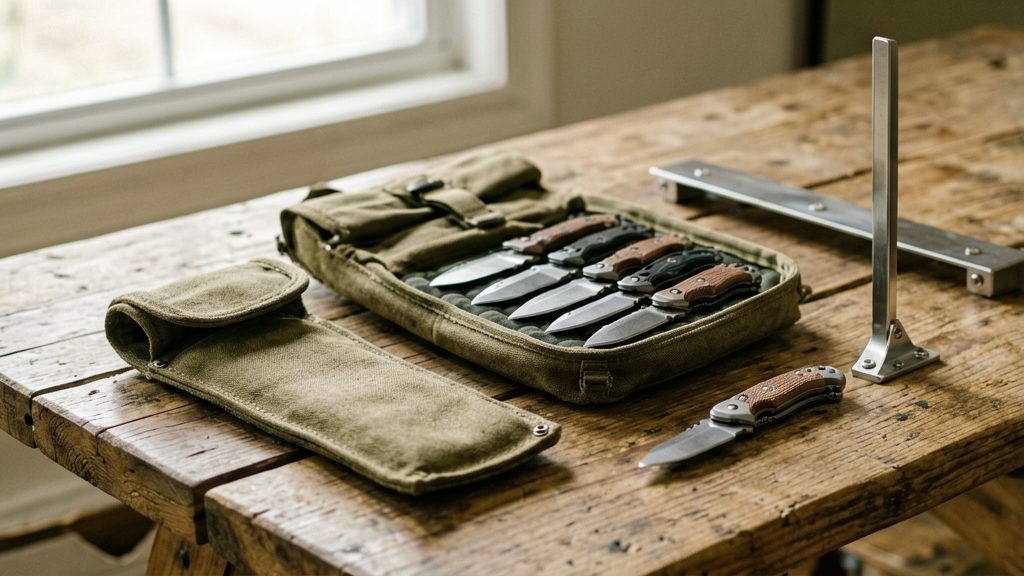
How do you choose a sheath or guard that actually fits?
A sheath encloses a blade and holds the knife in place. An edge guard generally covers the cutting portion for transport inside another container. Check the particular product’s intended use before treating these as interchangeable.
For a fixed outdoor knife, start with the sheath specified for that exact model. A replacement described only by approximate blade length may have the wrong shape around the tip, handle, or retention point.
For kitchen knives taken camping, compare these features before buying a guard:
- Blade length: The entire cutting edge and tip must remain covered when the knife is seated correctly.
- Blade height: A broad chef’s knife needs clearance from its spine to its edge. A narrow sleeve may leave the heel exposed.
- Blade thickness: The guard must accept the blade without being forced open or scraping aggressively along it.
- Handle clearance: The handle or bolster must not prevent full insertion.
- Retention: The cover should stay attached during ordinary packing and removal from the organizer.
Check fit on a clear work surface with the cutting edge directed away from your body. Keep fingers outside the sheath opening and away from the blade’s path. Follow the manufacturer’s insertion procedure; stop if the knife jams or requires excessive pressure.
Do not squeeze a fabric cover against the edge to judge its strength, or test retention by shaking a knife over your hand. If compatibility is unclear, ask the manufacturer to confirm the knife model and sheath combination.
For a bread knife, pay particular attention to the guard opening. Serrations should enter without catching the lining. A guard that snags repeatedly is a poor match even when the blade technically fits inside.
How should you pack and unpack knives at camp?
Give the knife package a dedicated place in your backpack, camp kitchen tote, or vehicle storage. Position it where you can remove it deliberately without searching through loose contents.
Before closing the outer container:
- Place each knife in its assigned compartment, following the organizer’s loading direction.
- Arrange handles so they can be identified and grasped without reaching across another blade.
- Keep heavy cooking equipment from bearing directly against handles, covers, or folding mechanisms.
- Close straps, flaps, and zippers without compressing the contents beyond the organizer’s intended capacity.
- Lift the closed package gently and check whether anything shifts or rattles. Reposition the contents if necessary.
An overfilled roll can be awkward to close and difficult to inspect. Remove unnecessary tools instead of forcing the closure around them. For backpacking, compare the packed bulk and weight of the complete setup, including its guards, rather than evaluating the empty bag alone.
At camp, set the package on a stable surface before opening it. Open flaps where you can see their contents, then remove the required knife by its handle. Avoid leaving an open roll at the edge of a crowded preparation table.
Choose a storage position that children and other campers cannot access accidentally. A carry strap or zipper is not a child-resistant feature. The American Knife and Tool Institute advises carrying knives with their blades shut or enclosed in a sheath. Knife safety guidance
Why can a knife rust inside protective storage?
An enclosure protects against some external hazards while also limiting your view of what is happening inside. If moisture enters with the knife, its cover, or a cleaning cloth, closing the container does not remove it.
Even corrosion-resistant steel can oxidize after exposure to moisture, salt, or acidity. The knife manufacturer’s care guidance, dated February 6, 2026, recommends drying blades after use and storing them in a dry environment.
After food preparation, clean the knife using its specified method. Pay attention to residue near the handle and, on a folding knife, around the pivot. Do not assume cleaning instructions for a fixed kitchen blade also permit soaking a folding mechanism.
Check the inside of the storage equipment separately. An apparently clean blade can pick up moisture or debris from its sleeve. If rain interrupts cleanup, keep the knife safely contained for the journey, then reopen and service the package as soon as practical.
When should you change the setup for storage between trips?
Travel storage and storage at home have different priorities. During a trip, the knife needs secure containment while the load moves. Between trips, you can choose a dedicated location that permits inspection without keeping everything bundled for immediate departure.
The same February 6, 2026 care guidance advises against leather sheaths for long-term storage because they can retain moisture. For fixed blades, it recommends a breathable sheath or removing the sheath during extended storage.
If you remove a sheath, place the knife in a dedicated holder or rack that supports it securely and prevents accidental contact with its edge. Do not interpret sheath removal as permission to leave a bare knife loose in a drawer.
Where the knife maker recommends a protective oil film, use a product suitable for the blade’s intended food contact and follow its application and removal instructions. Wipe away excess rather than leaving oil to collect in the storage lining. The American Knife and Tool Institute recommends protective oil for extended storage and removal of excess oil during maintenance. Maintenance guidance
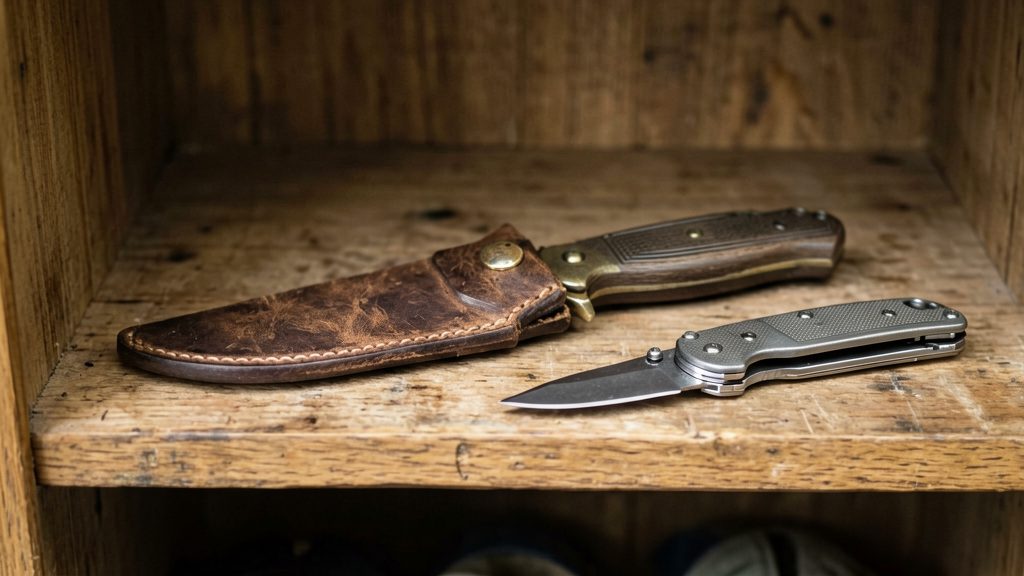
What damage means storage equipment needs attention?
Inspect storage equipment when packing for another trip and after a drop, crushing load, or blade snag. Look at the places that contain or retain the knife, rather than judging the equipment solely by its outside appearance.
| Inspection point | Problem to look for | Appropriate response |
|---|---|---|
| Sheath tip and seams | Puncture, split, or cut stitching | Stop using the damaged cover until repaired appropriately or replaced. |
| Retaining strap or molded opening | Loose fastener, torn attachment, or changed fit | Have compatibility and retention checked before carrying the knife again. |
| Guard interior | Embedded grit, torn lining, or material that catches the edge | Clean according to its instructions; replace it if damage prevents smooth insertion. |
| Roll closure | Torn webbing, failing buckle, or zipper that will not stay closed | Repair or replace the closure before transporting the loaded roll. |
| Hard-case rim and latch | Debris, damage, or an obstruction preventing full closure | Service it according to the case instructions before relying on the enclosure. |
A newly sharpened blade deserves a fresh fit check if sharpening has noticeably changed its profile. Do not reshape a molded sheath with improvised heat or modify a retaining feature unless the manufacturer provides a procedure.
If inspection also reveals a damaged knife handle, loose blade, or malfunctioning lock, put the knife aside for assessment. Replacing the storage container cannot correct a fault in the knife itself.
Frequently asked questions
Can cardboard and tape replace a knife sheath?
Choose a purpose-made guard or sheath for repeated camping use. An improvised cardboard cover provides uncertain retention and can deteriorate during handling or exposure to moisture.
What if a wooden-handled folding knife becomes difficult to open?
Wood movement can tighten the blade’s fit, according to the manufacturer’s guidance on smoother opening. Keep your fingers clear and follow the instructions for that exact knife rather than prying the blade out with another tool. Seek manufacturer support if normal operation does not return. Opening guidance
Can a sharpening stone travel in the knife organizer?
Use a separate protective pouch or compartment that prevents the stone from rubbing against the knives. Follow the stone maker’s instructions for draining, drying, and transport, especially after using a waterstone.